
Safety First, Fun Second
We want your time on Lake Coeur d'Alene to be the highlight of your summer. To make sure everyone stays safe and the memories stay positive, it’s important to brush up on the local 'rules of the lake.' Idaho has specific laws designed to protect boaters, swimmers, and our beautiful environment. Here’s a quick breakdown of what you need to know before we toss you the keys.
Pro-Tip: Keep an eye out for the yellow 'No Wake' buoys near the shore—they are strictly enforced on Lake CDA! Also, please remember that all passengers must be safely inside the vessel while it is moving. Sitting on the sunpad or the back of the boat while underway is illegal and a quick way to get a ticket from the water patrol.
While this guide covers the essentials for your rental day, Idaho’s boating regulations are comprehensive. For a deep dive into every regulation and to explore the full official study materials, head over to the Idaho Boat-Ed Study Guide.
Alcohol and Drugs
Idaho law prohibits anyone from operating or being in actual physical control of any vessel while under the influence of alcohol, drugs, or other intoxicating substances. Alcohol and drugs cause impaired balance, blurred vision, poor coordination, impaired judgment, and slower reaction times. Alcohol is a major contributor to boating accidents and fatalities.
Idaho law states that a person is considered to be “under the influence” if he or she:
Is 21 years of age or older and has a blood alcohol concentration of 0.08% or higher or...
Is under 21 years of age and has a blood alcohol concentration of 0.02% or higher.
Unlawful Operation
Idaho law designates the following dangerous operating practices as illegal.
Negligent Operation of a vessel is the failure to exercise the care necessary to protect the rights, safety, or property of others. Some examples of negligent operation are:
Boating in an area where buoys or other markers clearly mark a swimming area or some other restricted area
Becoming airborne while crossing the wake of another vessel at an unsafe distance from the vessel creating the wake
Weaving through congested waterway traffic
Swerving at the last possible moment in order to avoid a collision
Causing danger or damage from the wake of your vessel
Chasing, harassing, or disturbing wildlife with your vessel
Failure to Regulate Speed is operating at speeds that are too fast for the operator to bring the vessel to a stop within an assured clear distance ahead. It is illegal to exceed any posted speed limits. Specifically, the following acts are illegal.
Operating at a speed greater than “no wake speed” (maximum of five miles per hour) while within 100 feet of a dock, a swimmer, or a person in the water except when:
Safely pulling a water-skier from a dock
Safely dropping a water-skier at or near a dock
The swimmer or other person in the water is the vessel’s skier
Operating at a speed and proximity to another vessel that requires the other operator to swerve at the last moment to avoid a collision
Overloading or Overpowering is exceeding the carrying capacity or power limitations stated on the capacity plate installed by the vessel manufacturer, even if the vessel is a kayak or an inflatable raft.
Important Note on Capacity: It’s easy to focus on the number of seats, but Idaho law is very strict about the total weight limit (people + gear). If your group arrives and exceeds the weight limit for your reserved vessel, we will require you to upgrade to a larger boat to stay legal and safe. Please plan your guest list and gear accordingly!
You must not exceed the maximum allowed number of persons, maximum allowed pounds of persons, or maximum allowed combined pounds of persons and equipment.
Riding on the Bow, Deck, or Gunwale is allowing passengers to ride on the bow, gunwale, transom, seat backs, seats on raised decks, or any other place where there may be a chance of falling overboard.
Requirements to Tow a Person With a Vessel
The "Observer" Rule: We provide the flags you'll need, but remember you always need a dedicated observer in the back seat—not just the driver—whenever you've got someone on the skis or tube!
The "Life Jacket" Rule: We have plenty of life jackets available for all sizes. In Idaho, children 14 and under must wear them at all times while the boat is underway—it's the law, and it's the safest way to play.
Vessel operators towing a person(s) on water skis, aquaplanes, surfboards, inner tubes, or any similar devices have specific equipment and observer requirements.
Each person being towed behind a vessel must wear a USCG–approved PFD.
Every vessel towing a person(s) on water skis or a similar device must have a competent person, in addition to the vessel operator, continuously observing the towed person(s).
If the towing vessel is a PWC, the PWC must be rated by the manufacturer for at least three people—the operator, the observer, and the retrieved skier.
Vessels towing a person(s) on water skis or similar device must carry on board a red or orange skier-down flag. The observer must display the flag whenever the skier is in the water.
Vessel operators towing a person(s) on water skis, aquaplanes, surfboards, inner tubes, or any similar devices and the persons being towed must do so safely and responsibly.
It is illegal to tow a water-skier between one hour after sunset and one hour before sunrise.
It is illegal to exceed “no wake speed” (maximum of five miles per hour) while within 100 feet of a dock, a swimmer, or a person in the water, except when:
You are safely pulling a water-skier from a dock or…
You are safely dropping a water-skier at or near a dock or…
The swimmer or other person in the water is the vessel’s skier.
Vessel operators are responsible for the actions of any person they are towing.
Our Goal: Your Best Day on the Lake
We want you to have an epic day on the water, not a day spent talking to the sheriff. If you have any questions about these rules before you head out, just ask Kent or the team when you arrive at the docks!
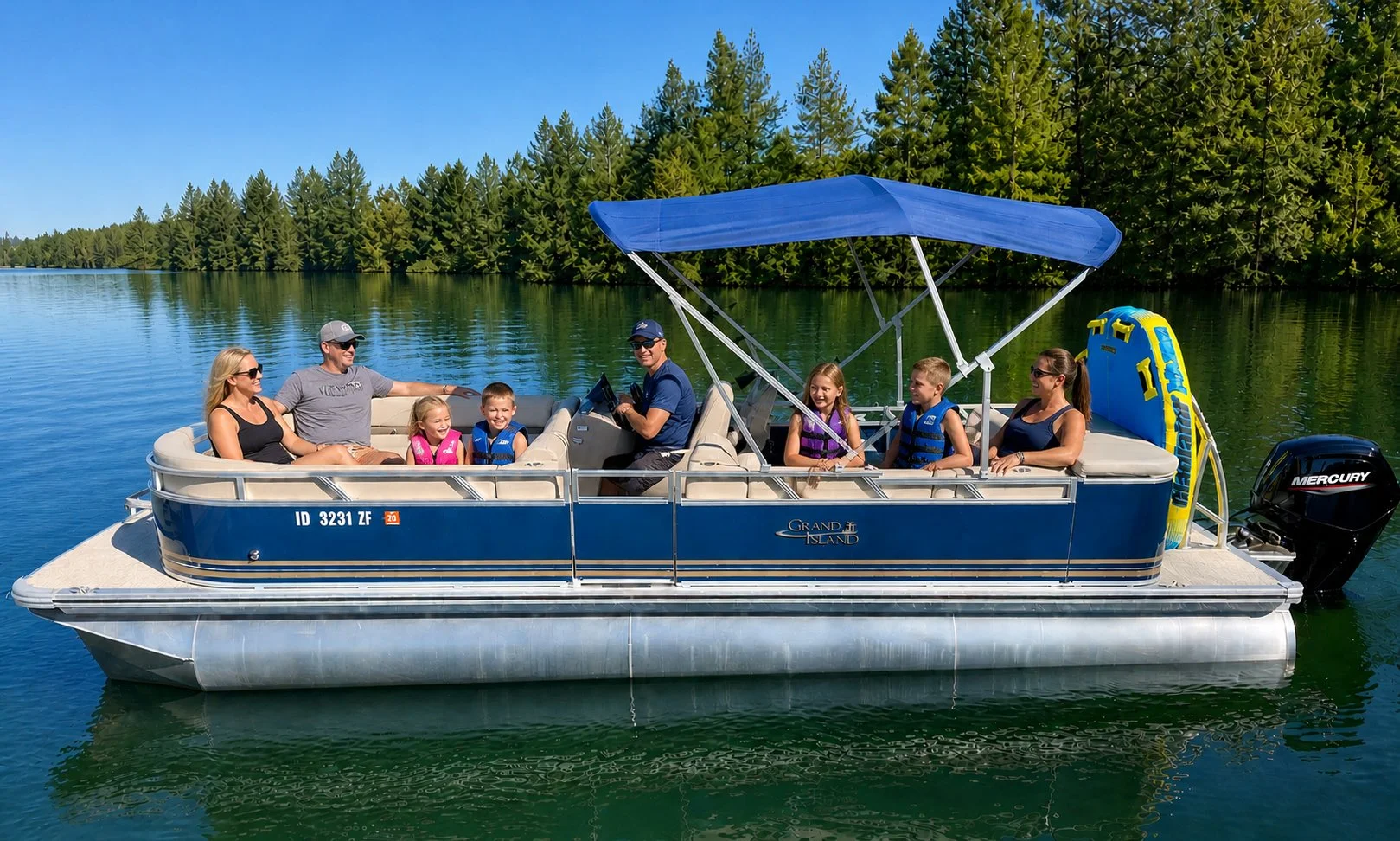
Family in our 25’ Premium Pontoon boat rental on Lake Coeur d'Alene — practicing safe boating.
